

No products in the cart.

Sliding vs Casement Aluminium Windows: What Hyderabad Architects Should Recommend
The right window style does not just change how a home looks. It changes how the room breathes, opens, and behaves every day.
Sliding windows move horizontally along tracks. Casement windows open outward or inward on hinges, similar to a door. Both are popular choices in modern aluminium window design, but they solve different problems.
For Hyderabad homes, the decision between sliding and casement aluminium windows should not be based only on trend or appearance. It should be based on room function, ventilation, view, privacy, noise, wind exposure, and available space.
Architects and interior designers play an important role here because homeowners often ask, “Which window is better?” The honest answer is: the better window is the one that suits the room.
In premium homes, villas, and apartments, choosing the right window type can improve comfort, usability, and long-term satisfaction.
Sliding Windows Are Best for Views and Space Saving
Sliding aluminium windows are widely used in Hyderabad apartments and villas because they are clean, practical, and space-efficient.
Since the panels move within the frame, they do not need extra opening space inside or outside. This makes them ideal for balcony openings, compact bedrooms, living rooms, utility areas, and high-rise apartments.
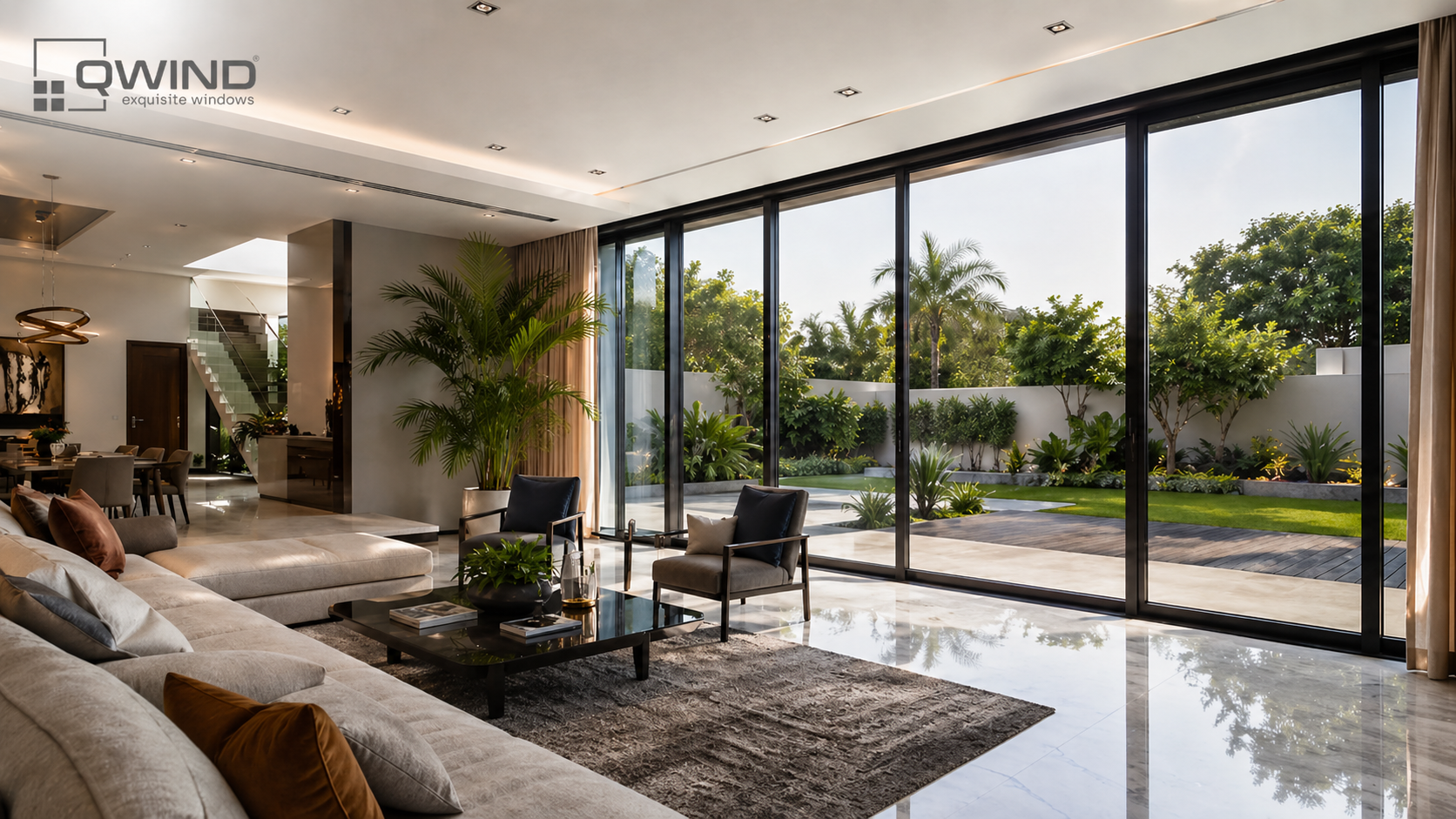
They also work well when the goal is to create wider views. Large sliding panels can make a living room feel more open and visually connected to the balcony or outdoor landscape.
For areas like Kokapet, Gachibowli, Narsingi, Tellapur, and Financial District, where many homes have balcony-facing views, sliding windows are often a strong choice.
They also support modern interior layouts because curtains, furniture, and wall panels can be planned more easily around them.
The limitation is that sliding windows may not offer the full opening area for ventilation because one panel usually overlaps another. This is why they should be chosen when view, access, and space-saving are the main priorities.
Casement Windows Are Best for Ventilation and Sealing
Casement aluminium windows are a strong option when airflow and sealing are important.
Because the shutter opens outward or inward, casement windows can allow better ventilation compared to many sliding formats. They can also create a tighter seal when closed, depending on the system quality.
This makes them useful for bedrooms, kitchens, bathrooms, study rooms, and road-facing areas where noise and air gaps need better control.
In Hyderabad, casement windows can work well in homes where cross-ventilation matters. For example, a bedroom facing an internal courtyard may benefit from a casement window that allows more airflow. A kitchen may need quick ventilation while cooking. A study may need quieter indoor conditions.
However, casement windows need opening clearance. An outward-opening shutter may not suit every façade, balcony, or high-wind location. An inward-opening shutter may disturb curtains or furniture.
So the recommendation should be careful and room-specific.
Choose Based on Room Function, Not One Standard Style
A common mistake is using one window type throughout the entire home.
Every room has a different role.
A living room may need a wide view and balcony connection. Sliding windows may be ideal.
A bedroom may need privacy, quietness, and controlled ventilation. Casement windows may perform better.
A kitchen may need airflow and easy operation. Depending on the layout, casement or sliding can both work.
A bathroom may need privacy and ventilation. A smaller casement, top-hung, or ventilator-style solution may suit better.
A villa façade may need a mix of fixed glass, sliding systems, and casement openings to balance design and function.
Good architecture does not force one solution everywhere. It chooses intelligently.
What Architects Should Check Before Recommending
Before recommending sliding or casement aluminium windows, architects should check five simple things.
First, the purpose of the room. Is it for rest, socializing, cooking, working, or utility?
Second, the view. Does the window need to frame a balcony, garden, skyline, or street?
Third, ventilation. Does the room need strong airflow or only occasional opening?
Fourth, space. Will the shutter movement interfere with furniture, curtains, grills, or outdoor restrictions?
Fifth, exposure. Does the window face strong wind, direct rain, harsh sun, or traffic noise?
Interior designers should also coordinate curtain tracks, blinds, furniture placement, wall paneling, and AC positions before the window type is finalized.
A window that looks good on paper can become inconvenient if daily use is ignored.
Common Mistake: Ignoring Hardware Quality
Whether you choose sliding or casement, the hardware decides the long-term experience.
For sliding windows, rollers, tracks, locks, interlocks, and brushes are critical. A large shutter with poor rollers will feel heavy and frustrating.
For casement windows, hinges, handles, friction stays, locking points, and gaskets matter. Poor hardware can lead to sagging, rattling, weak sealing, or difficult operation.
Many homeowners compare only frame color and price. But performance lives in the parts you do not notice immediately.
A premium aluminium window should open smoothly, close firmly, feel secure, and remain stable over time.
Real-World Example
An architect designing a villa in Jubilee Hills had a client who wanted sliding windows everywhere because they liked the modern look. But during planning, the architect studied each room more carefully.
The living and dining areas opened toward a landscaped garden, so large sliding aluminium windows were used to maximize the view. The bedrooms needed better ventilation and privacy, so casement windows were selected. The bathrooms used smaller ventilated openings. The staircase used fixed glass to bring in natural light.
The result was a home where every window had a reason. The client still got the modern look they wanted, but the house also performed better.
This is what good window planning does. It balances beauty with daily life.
Actionable Exercises
The Room Priority Map
Write each room name and choose one main priority: view, ventilation, privacy, noise control, access, or compact operation. Then select the window type accordingly.
The Daily Use Test
Imagine opening the window every morning and closing it every night. Will furniture block it? Will curtains interfere? Will it be easy to clean and operate? If not, rethink the style.
Practical Takeaways
- Sliding aluminium windows are ideal for wide views, balconies, and space-saving layouts.
- Casement aluminium windows are better for ventilation, sealing, and controlled airflow.
- Hyderabad homes often need a mix of sliding, casement, fixed, and ventilated window types.
- Hardware quality is as important as window style.
- Architects should recommend windows based on room function, not trend.
CTA
Need help choosing between sliding and casement aluminium windows for a Hyderabad project? Qwind Hyd offers window systems designed for modern homes, villas, apartments, and architectural spaces.